|

POKEMON RANGER CAPTURING POKEMON
 |
|
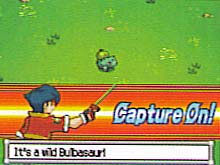
In Fiore, Rangers don't use PokeBalls to catch Pokemon as in traditional Pokemon games. Instead, they use Capture Stylers. These Stylers capture Pokemon by cleverly utilizing the DS' touch screen by drawing circles around the targeted Pokemon. And since the game has no battles or anything, this process has been drawn out to be the primary action of the game.
First of all, you have to find a Pokemon to capture it, and also unlike previous traditional games, you can actually see the Pokemon in their environments before you capture them. They might be just be strolling around until you get within range to capture it. This is done by walking up to it and coming in contact with it. If it notices you, it may charge at you or try to flee. If you know it will flee, it's best to approach it from behind. You can also capture multiple Pokemon at once, but in order to do this, the extra Pokemon should be within a reasonable distance.
Now, to capture them, just draw lines a certain number of loops around the Pokemon. This number differs from Pokemon to Pokemon, and the more powerful Pokemon usually require more loops to catch. This number is shown in blue above the Pokemon after you draw a successful loop around it. Usually, your target won't be so susceptible to capture, and it either attack the line that you are attempting to draw around it or run around in random directions to make the job much more difficult. And if that Pokemon breaks your line, you'll have to start back at its original number of loops required. |
It doesn't go on forever, though. After a while, yellow dashes will appear above the target Pokemon, and this is a sign that it is going to flee soon. You can also leave the attempt yourself by drawing a simple loop around it, releasing the stylus and selecting the option in the lower-left of the screen to flee. Furthermore and most importantly, your Styler has an energy gauge and if it reaches zero, it's game over and back to the last save point.
Your Styler takes damage only when a Pokemon attacks the line, not if it just touches it. The damage done is a constant based on the Pokemon's power, which is usually one or two for weaker Pokemon but around six for some strong ones. The amount of energy in your Styler depends on your Styler's level; the higher, the more energy. Leveling up the Styler is done with experience, but that's a little later on.
To replenish your Styler's energy, you can go to a Ranger Base and talk to an operator to fully recharge it, or you can use an Electric Poke Assist or the Recharge Field Move. Based upon the power of the Assist, which is also shown as the Field Move, you can charge your Styler by a certain amount. There are three levels of this, as with other Field Moves, and they replenish up to 5, 15 and all of your Styler's energy respectively.
Apart from your Styler's energy, there's another limit to the Styler. That's the line's length, and it also becomes greater when you level up. Some Pokemon are moving as you are trying to capture them, so having a longer line is better if you want to keep up with its movements more easily. Also, you can draw loops around your target and keep out of the Pokemon's attacking range. However, some attacks don't necessarily have ranges, so don't always go by that idea.
 |
|
As mentioned earlier, gaining experience is needed to level up the Styler and gaining it is done simply by capturing the Pokemon. Likewise to most other stats, it differs with the Pokemon. Experience is shown prior to the actual capture similar to how the remaining loops number is shown. However, this number is orange and has a plus (+) in front of it. This number can also usually rise if you continue to draw loops around the Pokemon. It will go to a maximum and stop rising from there. This will usually take around three to five extra loops to reach the maximum. Be careful though, if your line breaks, you'll be back where you started. Furthermore, if you want to gain even more experience, try catching multiple Pokemon at the same time.
So now that the background stuff is taken care of, let's go into some more intricate details. After all, it's not like you can just capture any Pokemon you like by merely drawing circles. Although that is the general concept, at some points, you may not be able to continue drawing those circles. You may not even know how the Pokemon behaves, so that would make the job difficult. To solve this, just take a moment and observe it. |
How do you observe a Pokemon? Well, it is quite as easy as it sounds, but here's a brief rundown of things that you can do. When you start the process, just wait a few seconds before putting the stylus down. The Pokemon might dart around or even attack already. After you're satisfied with how it moves, draw a line in the Pokemon's view and keep it down until it attacks you. This can tell you when and how often the Pokemon attacks or reacts to a drawn line. Try touching the Pokemon. That will tell you how the Pokemon responds to coming in contact with the line. You can also tell when the Pokemon is about to attack because when it does, it is signified by a lightning bolt above the Pokemon's head and the Pokemon's cry.

Let's take a look at Blastoise for example. It likes to walk around and occasionally blast out some jets of water. You should be able to know that at that time, you can't draw any loops around it. Now, if you wait for it to be done attacking and then rapidly draw some loops, it may be enough, but sometimes those periods aren't long enough. So, what should you do?
You may also have noticed that Pokemon tend to attack in certain patterns. They either attack in the direction they are looking in or in circles around them. Some examples would be a Meowth slashing directly at the line or a Quilava creating an explosion of fire around it. Furthermore, some attacks don't necessarily have any limit to their range and just go off the screen. So, with this knowledge of how the Pokemon attacks, you can know when the Pokemon will attack and what it does.
Now, the capture styler has some great characteristics to it that really make it easier to capture Pokemon. First, you can keep it engaged indefinitely as long as you don't lift the stylus. Also, when you make contact with another part of the line (like drawing a loop), the length of the line cuts off where you made the contact. This gives you back the remainder of the length to continue drawing loops and does not limit you or the Pokemon to that area that you previously drew that loop in. That means that you can erase some of your line if it is about to be attacked by something. Finally, you can move the end of your line by exceeding the line's total length. The end will move along the line at the same rate that you draw more of the line. That can save that part of the styler from getting attacked as well.
So, let's put this all to use on Blastoise. Put the end of your line near the bottom of the screen in the middle, so it is less likely to be targeted or hit by an attack. Then, in the intermissions between spurts of water, draw some small, quick loops around Blastoise and when it's about to attack again, return the tip of the line to the end of the line and touch it so that you won't be exposed to the attack. Continue this process until you can capture it. |
|
 |
Let's also apply this concept to something harder to catch, like Regice. Regice has a unique way of attacking, and this is done by ice pillars jutting out of the ground in zigzagging patterns on either the left or right half of the screen. Now, if you had observed it for a while, you could tell that it takes pauses every now and then, and when it's on the half that doesn't have interfering, that's your chance. Keep the end of your line in the bottom-middle of the screen, where it is not in the way of Regice's movements or the pillars. Again, continue until you can capture it.
You might think that I completely ignored or overlooked Poke Assists here, and I have, but there is a whole other guide for Poke Assists. For a quick summary, however, they are your ways of battling the Pokemon to make it more susceptible to capture. There are many types of them, and they use the Pokemon's groups to determine the effectiveness. If you need more information, check out the guide for a complete overview.
|